
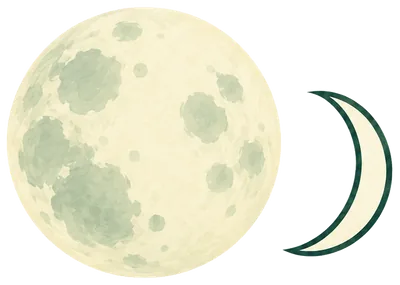
Full moon and new moon dates, October 2026 to October 2027
The next full moon is on 26 October 2026 at 04:12 GMT, with the Moon in Taurus; the next new moon is 9 November 2026 at 07:02 GMT. Every instant below is computed from the real positions of the Sun and the Moon and given in UK local time.
When it happens
| Phase | Exact instant (UK time) | Moon in | Eclipse |
|---|---|---|---|
| Full moon | Taurus | — | |
| New moon | Scorpio | — | |
| Full moon | Gemini | — | |
| New moon | Sagittarius | — | |
| Full moon | Cancer | — | |
| New moon | Capricorn | — | |
| Full moon | Leo | — | |
| New moon | Aquarius | Annular solar eclipse | |
| Full moon | Virgo | Penumbral lunar eclipse | |
| New moon | Pisces | — | |
| Full moon | Libra | — | |
| New moon | Aries | — | |
| Full moon | Scorpio | — | |
| New moon | Taurus | — | |
| Full moon | Scorpio | — | |
| New moon | Gemini | — | |
| Full moon | Sagittarius | — | |
| New moon | Cancer | — | |
| Full moon | Capricorn | Penumbral lunar eclipse | |
| New moon | Leo | Total solar eclipse | |
| Full moon | Aquarius | Penumbral lunar eclipse | |
| New moon | Virgo | — | |
| Full moon | Pisces | — | |
| New moon | Libra | — | |
| Full moon | Aries | — |
The year on one line, drawn from the same computed instants as the table. Bright discs are full moons, dark discs new moons; a ring marks the 5 that are eclipses.
What is actually happening
A full moon is a moment, not a night. It is the instant the Moon stands directly opposite the Sun as seen from the Earth — 180 degrees away along the ecliptic — with the whole of its sunlit face turned towards us. A new moon is the opposite instant: the Moon passing between us and the Sun with its dark side towards us, lost in the daytime glare. Each comes round once in about 29½ days, and each can be computed to the second.
Because it is one instant, it is the same instant everywhere on the Earth. The times above are that instant in UK clock time; a reader in Sydney sees the same full moon at a clock time ten or eleven hours later, which is why the date can differ from one time zone to the next and why an almanac has to say which zone it is using. This one uses UK local time, and moves between GMT and BST when the clocks do.
The sign given is the thirty-degree stretch of the ecliptic the Moon is in at that instant, counted from the March equinox point. These are the twelve names the app uses. They are not the constellations of the same names, which the Moon crosses on a different schedule.
An eclipse can happen only at one of these instants, and happens at only a few of them. The Moon's orbit is tilted about five degrees to the Earth's, so at most full moons it passes above or below the Earth's shadow, and at most new moons its own shadow misses the Earth. Only when the full or new moon falls near one of the two points where the orbits cross do the three bodies line up closely enough for a shadow to land. That happens in two seasons a year, about six months apart, and the table flags the ones that fall in the next twelve months.
How often, and for how long
The next twelve months hold 13 full moons and 12 new moons. Measured from the instants above, the gap from one full moon to the next runs from 29 days 10 h 35 min to 29 days 15 h 44 min, and averages 29 days 12 h 48 min over this year; the long-run average, the synodic month, is 29 days 12 h 44 min. The gap varies because neither orbit is a circle: the Moon moves faster when it is nearer the Earth, and the Sun's apparent motion, which the phase is measured against, is faster in January than in July.
It follows the Moon's own clock and nothing else. The times move an hour when the clocks change and not otherwise.
Why we compute this
Eondra is a daily timing brief. The Moon is a quarter of its number — the Moon today, out of 25, from its aspects to your own chart — and your lunar cycle, the angle between the day's Moon and your natal Sun, is another 15. Neither is the world's phase: a full moon is not a good day or a bad day in the number, and the brief does not say it is. What the phase gives you is a shared clock, and this page keeps it to the minute.
The same engine publishes solar and lunar eclipses for the next two years, void-of-course Moon times for the fortnight ahead, and how the number is built.